
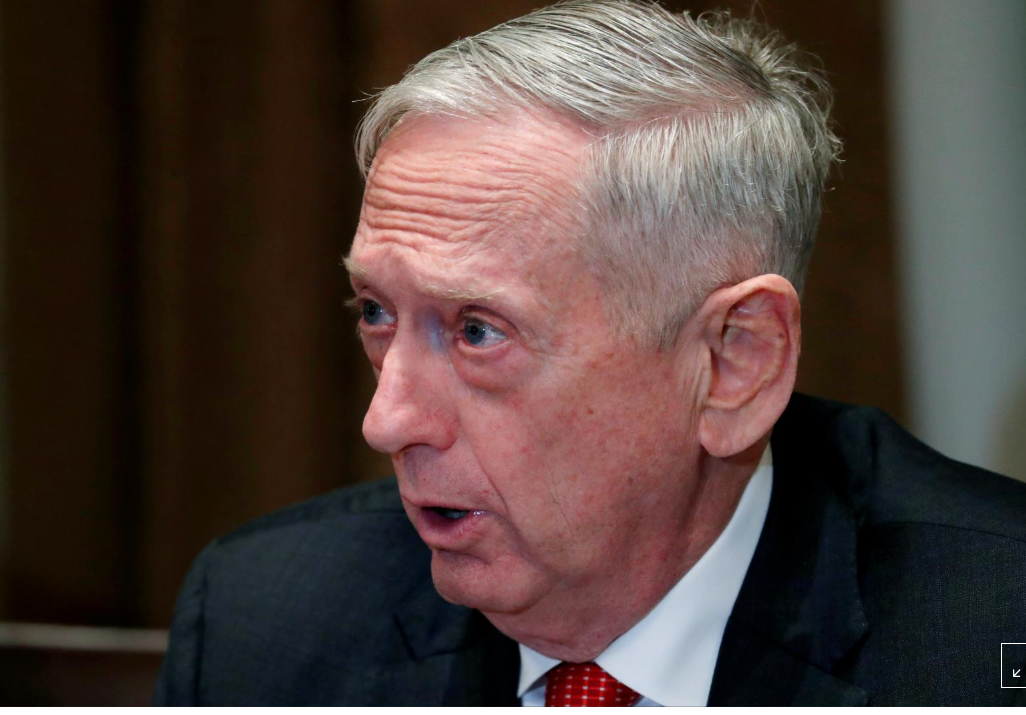
US Defense secretary Jim Mathis, a few days ago in Bahrain, raised a lot of leniency over his new political settlement in Yemen during the next phase.
Matisse was speaking on the sidelines of the Bahrain security Conference held in Manama, the Bahraini capital, earlier this week.
The U.S. Department of Defense website, the text of Minister Jim Mathis's speech, and the responses to journalists ' questions were published.
Matisse touched on a number of issues, including the Yemeni war, which called for an end to the war, and the start of a real settlement to end the worsening tragedy, which is worsening day after time, according to the official site of the country. According to the Russian Sputnik agency.
"All wars must end eventually and the tragedy of Yemen is getting worse day by day," Matisse said in response to reporters ' questions after his speech.
"Enough time has been wasted on secondary issues, and the time has come to move towards a halt to this war," he said. in November, we must begin to negotiate on the core issues. The settlement must replace the fighting, and people must have peace to heal. "
Matisse spoke about a part of the details of the settlement being prepared in Yemen, which is based on dividing Yemen into areas with autonomy after a gradual process of disarmament.
"I think the first part of the equation is to ensure that the border is demilitarized so that people do not feel that they have to put armed forces along the border," said the US secretary. There must be no more customs and border police there to speed up the flow of goods and people are going and coming legally. "
"Secondly, I think that disarmament is in a long, gradual schedule," he said. I'm saying we don't need rockets to go anywhere in Yemen anymore. No one will invade Yemen. We will return to the United Nations-backed government, giving the traditional areas to its indigenous people, so that everyone is in their areas, there is no need to control other parts of the country, and let the diplomats work to give their magic touches now. But that should start as I see along these two lines. "
In his speech, Matisse points out that Yemen is divided so that the areas currently under the control of the Houthis are self-governing by the militia, especially the "Province of", while the remaining liberated areas are divided between the government and the NTC, as well as the followers of Saleh.
"If we do, I think the Houthis will also find their chance, and they will have no better time than to engage with United Nations special envoy Martin Griffiths and his good staff in order to get what I think is their best interest and they will agree to make their best interest, which is, they are in Their region, they have some level of autonomy or some ability to synergize together and listen to their voices. They don't need any help from Iran to do this. "
"The United Nations can develop such a framework and prescriptions, as long as it involves not attacking outside their borders and we will not see Iran using other nations as quick bypass roads rather than respecting its sovereignty and using them as quick bypass roads to remove its destabilizing weapons," he said. Commercial traffic in the Gulf is disrupted or rockets are fired on Saudi civilian targets. "
But Mattis later denied, according to al-Arabiya channel close to the Saudi regime, what he termed "any talk about the intention to stop U.S. support for the coalition, but stressed the continued support and defense of the kingdom."
"Saudi Arabia and the Coalition for the support of legality are seeking to restore the internationally recognized government of President Abed Rabbo Mansour Hadi to Sanaa, which has been occupied by the Houthis backed by Iran," he said.


